


The idea is simple. A rocket trajectory or multiplier line rises from the start of the round and may stop at any random moment. The player’s task is to cash out before the Crash. If the flight ends first, the active stake is lost. Try it with BC Game AU.

Last used 6 minutes ago
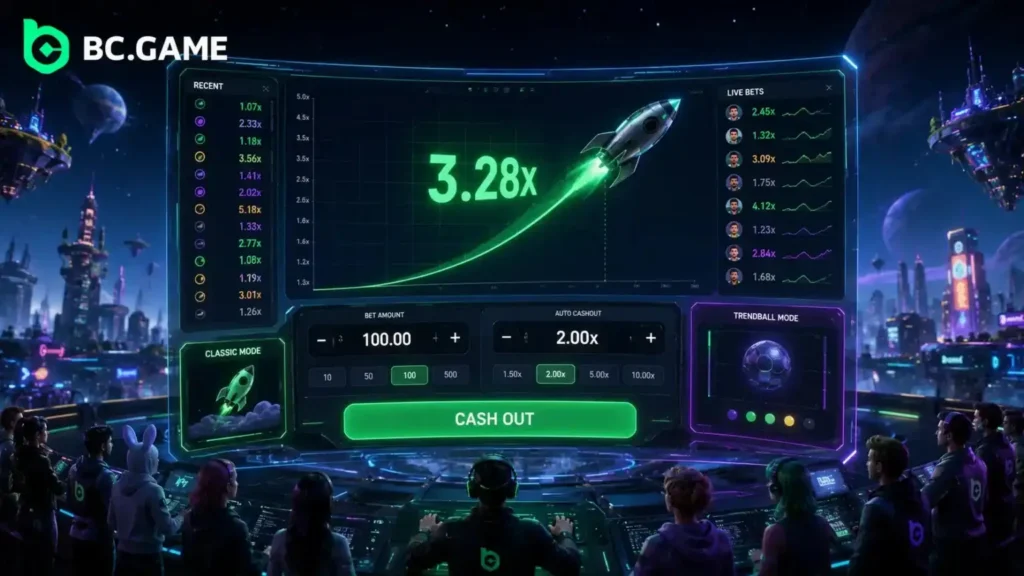
Core Gameplay Architecture of the BC Game Crash Interface
The interface is built around speed. Players can watch the multiplier, set stake values, follow recent outcomes, and compare community cashout points without opening extra menus.
The main interactive areas and control elements include:
- Live Multiplier Canvas showing the active rocket trajectory;
- Betting Control Console for stake and auto-cashout settings;
- Real-Time History Bar displaying recent multiplier outcomes;
- Global Community Log tracking live wagers and cashout timing.
Every block updates in real time, which matters in a game where one second can change the result.
The two main gameplay styles create different pacing:
- Classic Mode focused on manual cashout timing;
- Trenball Mode centered on predicting color or multiplier zones.
Classic mode usually suits users who want direct multiplier control and a rising multiplier format. Trenball is more attractive for players who prefer fixed zone-based predictions instead of cashing out during a flight.
Step-by-Step Tutorial: How to Initiate Your First Round Safely
New players should begin with small stakes and watch several rounds before betting. This helps them understand the rhythm of low, medium, and rare high multipliers.
A safe first-round setup normally follows these steps:
- Authenticate your account and check wallet availability.
- Open the BC Originals category and launch the official game module.
- Enter the preferred stake amount in the betting field.
- Configure an optional automatic multiplier target.
- Press the bet button before the round timer reaches zero.
Many Australian users start with conservative targets before testing more aggressive timing.
Last used 6 minutes ago
Cryptographic Transparency: The Provably Fair Algorithm Explained
Trust is essential in Crash games because outcomes happen quickly. The BC Game Crash system uses Provably Fair architecture designed to prevent post-round result changes.
Round outcomes are generated through server seeds, client seeds, and nonce tracking. The multiplier is mathematically set before the animation begins, while the rocket only visualizes the already calculated result.
| Game Mode | Target Mechanics | Visual Theme | Auto-Cashout Compatibility |
| Classic Mode | Manual cashout timing | Rocket trajectory | Yes |
| Trenball Mode | Predicting result zones | Color/range-based | None (Zone-based betting) |
This structure lets users check completed rounds independently instead of relying only on the visual interface.
Verification Workflows: Auditing Crash Results via Public Ledger
After a round ends, users can copy the generated hash and compare it through a Provably Fair verification tool. The goal is not to predict the next result. Verification confirms that the completed multiplier matched the value created before launch.
Mathematical Probability Matrices and House Edge Parameters
Crash is a volatility-based game. Lower multipliers appear more often, while extreme targets become increasingly rare. The house edge is commonly presented around 1%, but that figure does not promise profit. It only describes the long-term mathematical margin across very large samples.
| Target Multiplier | Statistical Probability | System Return Index | Suggested Risk Category |
| x1.20 | High | Stable | Low |
| x2.00 | Moderate | Balanced | Medium |
| x10.00 | Low | Volatile | High |
| x50.00 | Very low | Extreme variance | Extreme |
Higher targets create stronger pressure because one late cashout can erase several successful conservative rounds.
The «Instant Crash» Phenomenon: Understanding the 0.00x – 1.00x Triggers
Some rounds end almost instantly. These short outcomes are part of the probability model and help maintain the house edge structure.
New players sometimes read instant Crashes as suspicious, but very early results are normal in multiplier games. Without them, the payout distribution would become mathematically unbalanced.
Last used 6 minutes ago
Strategic Bankroll Management: Optimization Tactics for Long Sessions
Bankroll control matters more in Crash games than in slower casino formats. Rounds move quickly, and emotional decisions can escalate losses before the player notices.
The most practical capital allocation approaches include:
- Conservative low-multiplier targeting with lower volatility exposure;
- Separating small steady entries from faster speculative rounds;
- Ending sessions after reaching predefined win or loss limits;
- Keeping single-round exposure below a small wallet percentage.
Short sessions with fixed limits usually give better control than long recovery-driven play. This is also where strategic differences belong: conservative targeting and faster speculative play are bankroll choices, not separate Crash game modes.
The Risks of Progressive Betting Systems in High-Velocity Games
Progressive systems such as Martingale are risky in Crash mechanics. A few failed rounds can force sharp stake increases, and table limits may stop the recovery sequence before it works.
In BC Game Crash, aggressive doubling can drain an AUD wallet quickly. Such systems should never be treated as profit models.
Automation Features: Configuring Advanced Scripts and Autobet
Automation helps reduce panic decisions. Instead of reacting manually every round, users can define stake size, cashout targets, and behavior after wins or losses.
A standard automation setup normally follows these steps:
- Switch the interface from Manual mode to Advanced Auto.
- Enter the base wager amount.
- Configure the automatic multiplier target.
- Define behavior rules for wins and losses.
Automation can improve discipline, but it does not remove volatility or financial risk.
Writing and Loading Custom Script Frameworks
Advanced users may experiment with Lua or JavaScript-based scripts supported inside the interface. Scripts can automate repetitive betting intervals, stake changes, or multiplier targeting.
They should not be seen as predictive tools. A script only follows instructions; it cannot change the underlying probability model.
Last used 6 minutes ago
Gamified Infrastructure and Passive Loyalty Accumulation

Each completed round may contribute to internal progression. Activity inside BC Game Crash can generate XP, loyalty tracking volume, and automated account metrics.
The built-in automated reward structures include:
- Continuous rakeback accumulation connected with wager activity;
- Additional access to Lucky Spin progression levels;
- Eligibility for automated chat-rain distribution systems;
- Weekly and monthly cashback tracking inside the dashboard.
Because Crash rounds are fast, wagering volume can build quicker than in slower live-table games.
Rakeback Optimization Vectors via High-RTP Game Options
Fast cycles naturally increase turnover. For some users, that means loyalty metrics and rakeback structures update more quickly during active sessions.
This does not reduce gambling risk. It only explains why high-frequency games interact strongly with passive return systems.
Last used 6 minutes ago
Mobile Performance Optimization: Gaming on the Move in Australia

Crash timing depends on responsiveness, especially near high multipliers. The mobile version uses HTML5-style optimization to support smooth animation and quick input across Australian networks such as Telstra, Optus, and Vodafone.
Creating a quick-access mobile shortcut usually follows these steps:
- Open the platform through Chrome or Safari.
- Navigate directly to the Crash interface page.
- Choose «Add to Home Screen» from the browser menu.
This shortcut behaves like a lightweight web app without requiring a large installation file.
Preventing Network Latency Issues During High-Multiplier Rounds
To reduce connection problems, players should close heavy background apps, clear browser cache periodically, use stable 4G or 5G instead of weak public Wi-Fi, and avoid switching networks during live gameplay. Even small latency spikes can affect manual cashout timing.
Troubleshooting Connection Dropouts and Bet Settlement Discrepancies
Most technical problems during Crash sessions come from network interruptions, browser desynchronization, or delayed balance refreshes.
The most common troubleshooting scenarios include:
- Bet slippage caused by delayed cashout clicks;
- Visual desynchronization between graphics and server tracking;
- Temporary disconnections during network switching;
- Delayed balance refreshes after profitable rounds.
When issues occur, users should check round history and transaction records before assuming a settlement failure. Often, the backend ledger updates correctly even if the visible animation freezes.
Last used 6 minutes ago
Conclusion: Why Crash Remains an Industry Benchmark for Transparency

Crash remains popular because it combines simple rules with real mathematical tension. One rising multiplier creates timing pressure, probability management, and fast decision-making within seconds.
For Australian players interested in blockchain gaming, BC Game Crash offers Provably Fair verification, automation tools, mobile responsiveness, and clear multiplier mechanics. The game still carries normal gambling risk, but its open verification model helps explain why it remains a reference point in crypto gaming.