


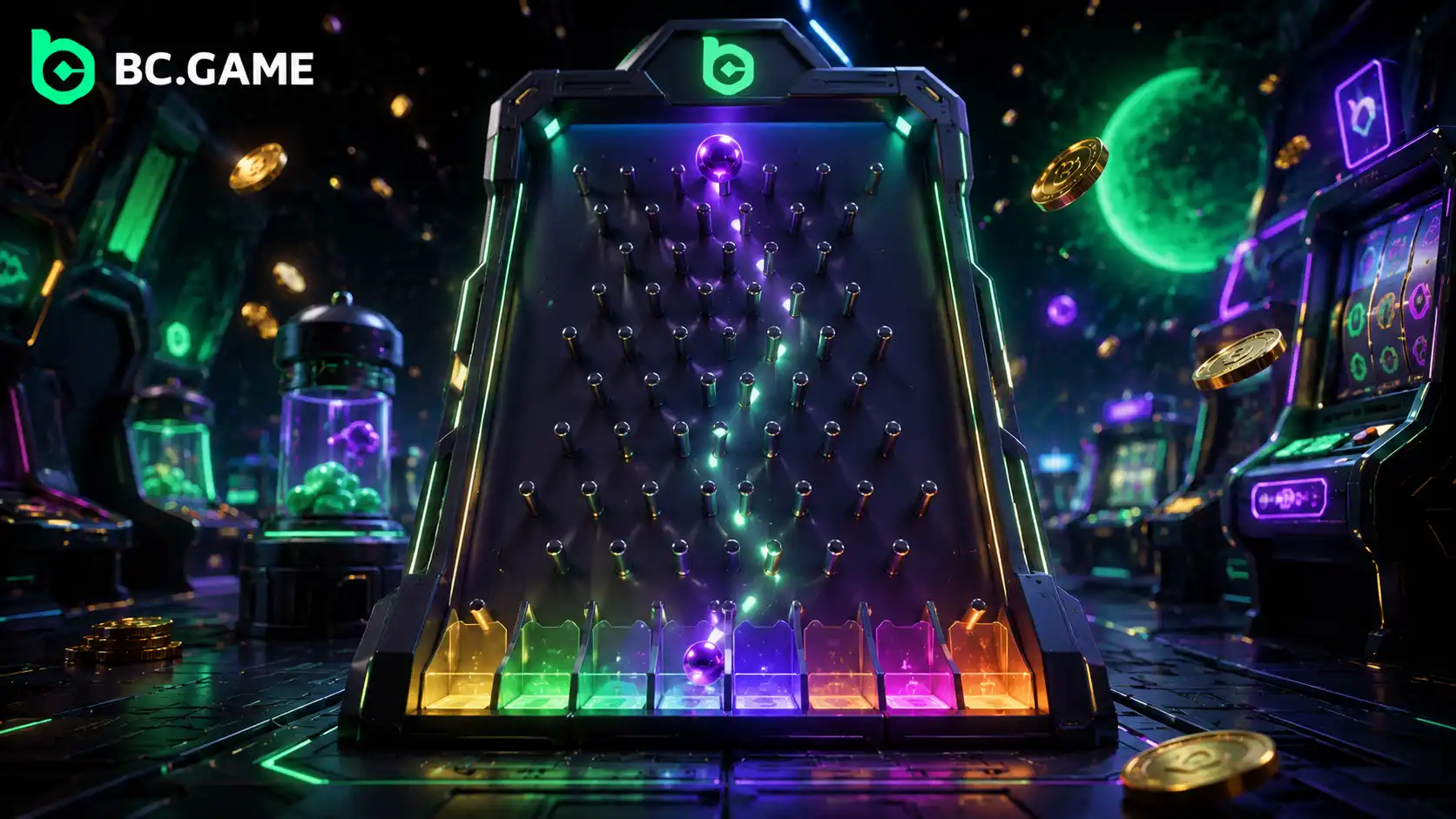
The concept is based on a classic Galton board structure. A ball falls from the top of a pyramid filled with pins, bouncing left or right at random until it lands in one of the bottom pockets. Each slot contains a different payout multiplier. Central pockets appear more frequently and usually hold smaller values, while edge pockets are mathematically harder to reach and therefore offer much larger rewards. You can find it at BC.Game Australia.

Last used 6 minutes ago
Core Interface Layout and Configuration Panels of BC Game Plinko

The interface is designed around customization. Australian users can adjust volatility, pyramid depth, stake size, and automation settings before every round instead of relying on one fixed configuration.
The main adjustable interface parameters include:
- Risk Level Selector with Low, Medium, and High volatility setups;
- Row Counting Grid allowing expansion from 8 to 16 rows;
- Betting Value Field where the active stake is configured;
- Manual/Auto Toggle controlling single or continuous ball drops.
These settings directly affect volatility and payout behavior. A small change in rows or risk level can create a very different mathematical experience.
The three risk structures also create distinct gameplay styles:
- Low Risk focused on smaller but more stable outcomes;
- Medium Risk balancing volatility and multiplier spread;
- High Risk prioritizing rare but extreme payout potential.
Lower-risk layouts usually suit cautious bankroll management, while high-risk configurations create sharper swings and larger multiplier variance. Row count should be treated as a separate configuration layer: expanding the grid from 8 to 16 rows increases trajectory complexity and changes how far the ball can travel before reaching a pocket.
Last used 6 minutes ago
Step-by-Step Tutorial: Launching Your First Ball Cascade Safely
New players should begin with moderate settings instead of immediately selecting extreme volatility. Watching several ball drops first also helps users understand how central clustering works inside the pyramid.
A safe setup process usually follows these steps:
- Complete account authentication and confirm wallet availability.
- Open the BC Originals section and launch the official game application.
- Select the preferred risk level and row count.
- Enter a stake amount that fits the planned bankroll size.
- Press the bet trigger to release the ball from the top of the pyramid.
Many Australian users begin with Medium Risk and fewer rows before experimenting with larger variance structures later.
Understanding Volatility: The Synergy of Risk Levels and Pyramid Rows
Rows and risk settings completely reshape the probability model. Smaller pyramids generate tighter distributions, while larger structures increase the distance between common outcomes and rare edge-pocket multipliers.
Under low-risk conditions, the game usually returns smaller but more frequent payouts. At the opposite extreme, a 16-row High Risk setup may unlock theoretical multipliers approaching x1000, although such outcomes are statistically rare.
| Risk Tier | Number of Rows | Minimum Multiplier | Maximum Peak Multiplier |
| Low | 8 | x0.5 | x5.6 |
| Medium | 10 | x0.4 | x22 |
| High | 16 | x0.2 | Up to x1000 |
The important point is that volatility changes faster than many players expect. Moving from an 8-row Low Risk layout to a 16-row High Risk layout changes the visible range from x0.5–x5.6 to x0.2–x1000, so the setting affects both downside exposure and rare peak potential.
The Mechanics of the High-Risk 16-Row Layout
The extreme 16-row structure creates the longest possible path through the pyramid. Every additional row increases the number of directional decisions the ball must make before reaching a bottom pocket.
Edge positions become mathematically difficult because the ball must continue moving in nearly one direction repeatedly. That is why the highest multipliers appear near the edges instead of the center.
Cryptographic Transparency: Verifying Plinko via Provably Fair Algorithms
Transparency is essential in digital arcade games because the ball path appears random to the player. In BC Game Plinko, trajectory generation relies on Provably Fair architecture designed to prevent hidden manipulation after the round begins.
Each ball path is connected to server seeds, client seeds, and nonce tracking systems. These values combine to create a cryptographic result before the visual animation starts.
The main fairness verification components include:
- Unique server seeds hashed before round execution;
- Customizable client seeds adding user-defined entropy variables;
- Public verification tools for mathematical result checking;
- Nonce counters tracking sequential ball releases.
This framework allows players to audit completed rounds independently instead of relying only on visual animation.
How to Use the Built-In Fairness Calculator
A standard verification workflow normally follows these steps:
- Open the completed round details from the personal history section.
- Copy the associated hash information and nonce values.
- Paste the data into the verification calculator.
- Compare the generated trajectory with the completed result.
The purpose of verification is not predicting future outcomes. It confirms that the finished result was generated mathematically before the animation began.
Last used 6 minutes ago
Mathematical Distribution Laws: The Galton Board Probability Model
Plinko follows the same mathematical principles as a Galton board. Over long samples, ball paths tend to create a binomial distribution where most results gather near the center of the pyramid.
That is why lower multipliers appear more frequently. Extreme edge pockets represent statistical outliers rather than expected outcomes.
| Pocket Position | Multiplier Profile | Relative Probability | Expected Return Trend |
| Central pockets | Lower multipliers | Highest | Stable |
| Mid-range pockets | Medium multipliers | Moderate | Variable |
| Edge pockets | Extreme multipliers | Lowest | Highly volatile |
This structure explains why emotional reactions often misread volatility. Rare outcomes can happen suddenly, but mathematically they remain uncommon even during long sessions.
Evaluating House Edge Parameters on Proprietary Arcade Titles
Theoretical RTP in Plinko is commonly presented around 99%, which corresponds to a house edge close to 1%. That figure describes long-term probability modeling rather than short-session guarantees.
A high RTP does not remove risk. Variance still plays a major role, especially in high-row and high-risk configurations.
Last used 6 minutes ago
Advanced Automation Systems: Configuring Continuous Ball Streams
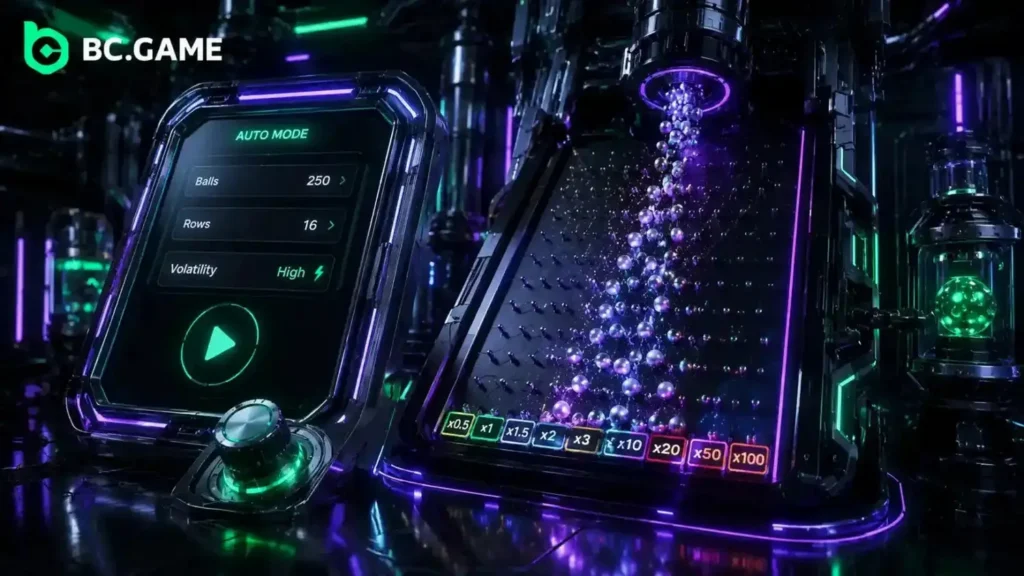
Automation tools allow users to release multiple balls continuously without manually pressing the bet trigger every round. This creates a faster visual flow and reduces repetitive clicking during longer sessions.
A standard automation setup normally follows these steps:
- Switch the configuration panel from Manual to Auto mode.
- Define the desired number of ball releases.
- Select the preferred combination of rows and volatility.
- Start the automated cascade sequence.
Fast automation can increase balance fluctuations quickly, especially when large row counts and aggressive volatility settings are combined.
Managing Balance Drops in Fast-Paced Multi-Ball Auto Sessions
Rapid automatic releases can consume an AUD balance faster than expected because dozens of rounds may complete within minutes. Conservative users often place strict stop-loss limits before enabling automation.
Smaller stake sizing and shorter session windows usually provide better control during continuous multi-ball sequences.
Loyalty Integration and Automated Progression for Plinko Enthusiasts
Every completed round contributes to internal account progression systems. Frequent activity inside BC Game Plinko may generate loyalty metrics, passive rakeback structures, and automated progression tracking.
The built-in automated reward structures include:
- Passive rakeback accumulation from active wagering;
- Additional contribution toward higher VIP progression levels;
- Eligibility for automated chat-rain distributions;
- Additional Lucky Spin activation allocations.
Because Plinko rounds finish quickly, active users can generate large wagering volume within relatively short periods.
Accumulating VIP Experience Points Through High-Frequency Rounds
Arcade games with rapid round cycles naturally create faster progression tracking compared with slower formats such as live roulette or baccarat. Continuous activity allows loyalty systems to update more frequently during active sessions.
This does not reduce financial risk, but it explains why high-frequency arcade games interact strongly with automated progression systems.
Last used 6 minutes ago
Mobile Execution and Fluid Graphic Rendering in Australia

Modern Plinko interfaces rely on smooth visual rendering because the ball trajectory must remain clear even during fast cascades. HTML5 optimization helps maintain responsive performance across Australian mobile networks such as Telstra and Optus.
A lightweight mobile shortcut setup normally follows these steps:
- Open the platform using a preferred mobile browser.
- Navigate to the Originals section.
- Choose «Add to Home Screen» from the browser options menu.
The resulting shortcut behaves similarly to a lightweight web application without requiring a large installation package.
Minimizing Input Latency on Touchscreen Game Layouts
The mobile interface uses enlarged controls and adaptive layouts to reduce accidental touches during stake configuration. Responsive spacing also improves usability on smaller iOS and Android screens where quick input matters.
Stable 4G or 5G connections generally provide smoother rendering than overloaded public Wi-Fi environments during rapid multi-ball sequences.
Troubleshooting Visual Freezes and Bet Settlement Delays
Most technical problems in Plinko sessions come from local browser instability, temporary synchronization delays, or interrupted mobile connectivity rather than incorrect calculations.
The most common troubleshooting scenarios include:
- Graphical freezes while backend calculations continue normally;
- Delayed wallet balance updates after rare multiplier hits;
- Session interruptions caused by mobile tower switching;
- Cached browser assets failing to render correctly.
In many situations, the backend ledger records the round outcome correctly even if the local animation appears delayed or frozen.
Validating Discrepancies via the Personal Bets History Ledger
When visual lag appears, users can open the «My Bets» section and review the exact mathematical outcome recorded by the server. The ledger stores the completed result regardless of whether the full animation finished on screen.
This history panel is usually the most reliable place to confirm completed trajectories, payout values, and round timing after connection interruptions.
Last used 6 minutes ago
Conclusion: Why Plinko Represents the Pinnacle of Modern Transparent Gaming

Plinko combines visual simplicity with surprisingly deep mathematical structure. Adjustable rows, volatility customization, and probability distribution models create a game that feels accessible to new users while still offering analytical depth for experienced players.
For Australian users interested in transparent arcade-style gambling, BC Game Plinko stands out because of its Provably Fair verification model, configurable volatility system, and responsive mobile performance. The game still carries normal gambling risk, but its open mathematical structure helps explain why it remains one of the most recognizable titles in modern crypto gaming.